
Investors and business leaders
Seeking a deeper understanding of South Sudan's investment environment.
From Abundance to Transformation
Opportunities, Risks, Reforms, and Pathways to Economic Transformation
Volume I: Foundations, Corridors, and Market Access
A comprehensive examination of the institutions, investment conditions, trade corridors, market-access systems, and reforms that will shape South Sudan's ability to convert national abundance into productive and sustainable economic value.
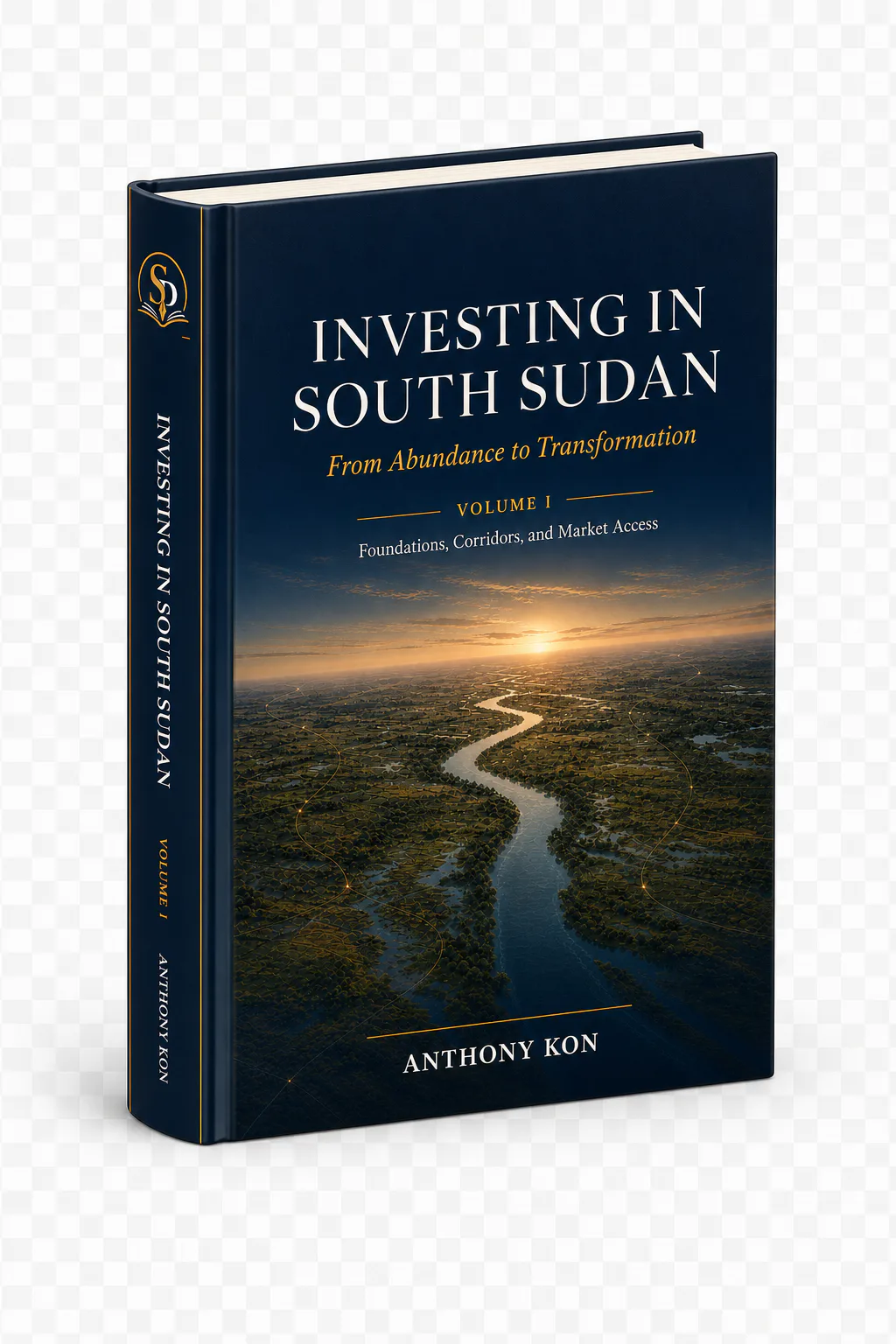
THE INVESTMENT QUESTION
South Sudan possesses substantial natural resources, agricultural potential, water, livestock, energy resources, a young population, and a strategic location connecting Eastern, Central, and Northern Africa.
Yet resources alone do not create prosperity.
The central question examined in Investing in South Sudan: From Abundance to Transformation is how these endowments can be organised through credible institutions, functioning markets, productive investment, infrastructure, regional connectivity, and effective public policy.
Rather than presenting South Sudan either as a market of unlimited opportunity or solely through the language of conflict and fragility, this two-volume work examines both opportunity and risk.
Its central argument is that South Sudan’s long-term economic future will depend not simply on what the country possesses, but on its ability to build the systems capable of transforming those resources into production, employment, exports, income, and sustainable national value.
“Yet resources alone do not create prosperity.”
ABOUT VOLUME I
Volume I examines the foundations upon which investment decisions are made and productive economic activity becomes possible.
It focuses on the conditions that strengthen investor confidence and create a more enabling environment for domestic and international investment.
The analysis covers constitutional, legal, institutional, fiscal, commercial, logistical, and regional frameworks that influence the ability of investment to enter the market, operate effectively, expand, and contribute meaningfully to national development.
BOOK STRUCTURE
Review the complete structure of Volume I: Foundations, Corridors, and Market Access, including its major parts, chapters, and principal areas of analysis.
Detailed headings are presented without page numbers for web readability.
For a landlocked economy, transport corridors are not merely infrastructure routes. They are part of the investment environment itself.
Volume I therefore examines the systems through which South Sudan connects to ports, neighbouring economies, regional markets, and international trade.
The book considers the strategic importance of road, rail, river, air, and multimodal transport systems, together with border administration, customs procedures, transit arrangements, container logistics, inland facilities, and regional trade agreements.
It also explores the opportunities and constraints associated with South Sudan’s principal and emerging commercial gateways and corridors.
How can South Sudan reduce the cost and uncertainty of moving goods, capital, inputs, and exports between domestic production centres and regional and international markets?
Trade is essential. It keeps goods, services, and inputs moving through an economy and connects producers and consumers to markets.
But trade alone cannot create the productive foundations required for long-term economic transformation.
The book therefore distinguishes between commercial exchange and productive investment.
Productive investment builds assets, expands domestic production, transfers knowledge and skills, creates employment, generates value added, strengthens exports, and broadens the economic base.
The objective is not to choose between trade and investment. South Sudan requires both.
The deeper challenge is to create an economy in which increasingly greater value is produced, developed, and retained within the country.
The book does not argue that investors should ignore risk.
Nor does it treat South Sudan's natural abundance as a guarantee of economic success.
Instead, it asks how risk can be better understood, managed, and reduced through stronger institutions, clearer procedures, reliable data, improved coordination, responsible partnerships, and more predictable economic governance.
Resources and opportunities do not become productive capacity by themselves.
They require institutions that function, policies that encourage productive activity, infrastructure that connects markets, and investments capable of converting opportunity into viable projects with measurable economic impact.
The analysis draws upon laws and regulations, government and institutional policy documents, trade and transport reports, logistics studies, sectoral research, regional integration frameworks, development strategies, and institutional assessments.
These sources are complemented by field observations, professional experience, historical context, and an examination of the practical economic conditions encountered by farmers, traders, investors, officials, communities, and private-sector actors.
Where data are incomplete or estimates differ, the book identifies those limitations rather than presenting uncertain figures as absolute fact.
It also distinguishes between what laws and policies formally provide and how institutions and procedures may operate in practice.
Intended Readers
Designed for readers working across investment, policy, diplomacy, development, research, and South Sudan's long-term economic transformation.
Seeking a deeper understanding of South Sudan's investment environment.
Working on economic reform, infrastructure, trade, investment, and regional integration.
Engaged with South Sudan and the wider Eastern African region.
Assessing projects, reforms, and investment-enabling systems.
Studying development, investment, regional integration, political economy, and African markets.
Contributing knowledge and experience to the country's long-term economic transformation.
Exploring responsible pathways for capital, skills, networks, and enterprise.
Two-Volume Framework
“Examines the institutional, legal, financial, commercial, logistical, and regional foundations required for investment, trade, connectivity, and access to markets.”
“Builds on these foundations to examine how productive sectors, stronger institutions, and integrated economic systems can generate broader and more durable development.”
Inside Volume I
Explore selected material from Volume I, including the Author's Note, sample pages, maps, and figures.
“This two-volume work is written from conviction, but not from illusion. Its purpose is neither to embellish reality nor to diminish it, but to examine South Sudan's opportunities, risks, reforms, and pathways to economic transformation with honesty, discipline, and a constructive sense of national purpose.”
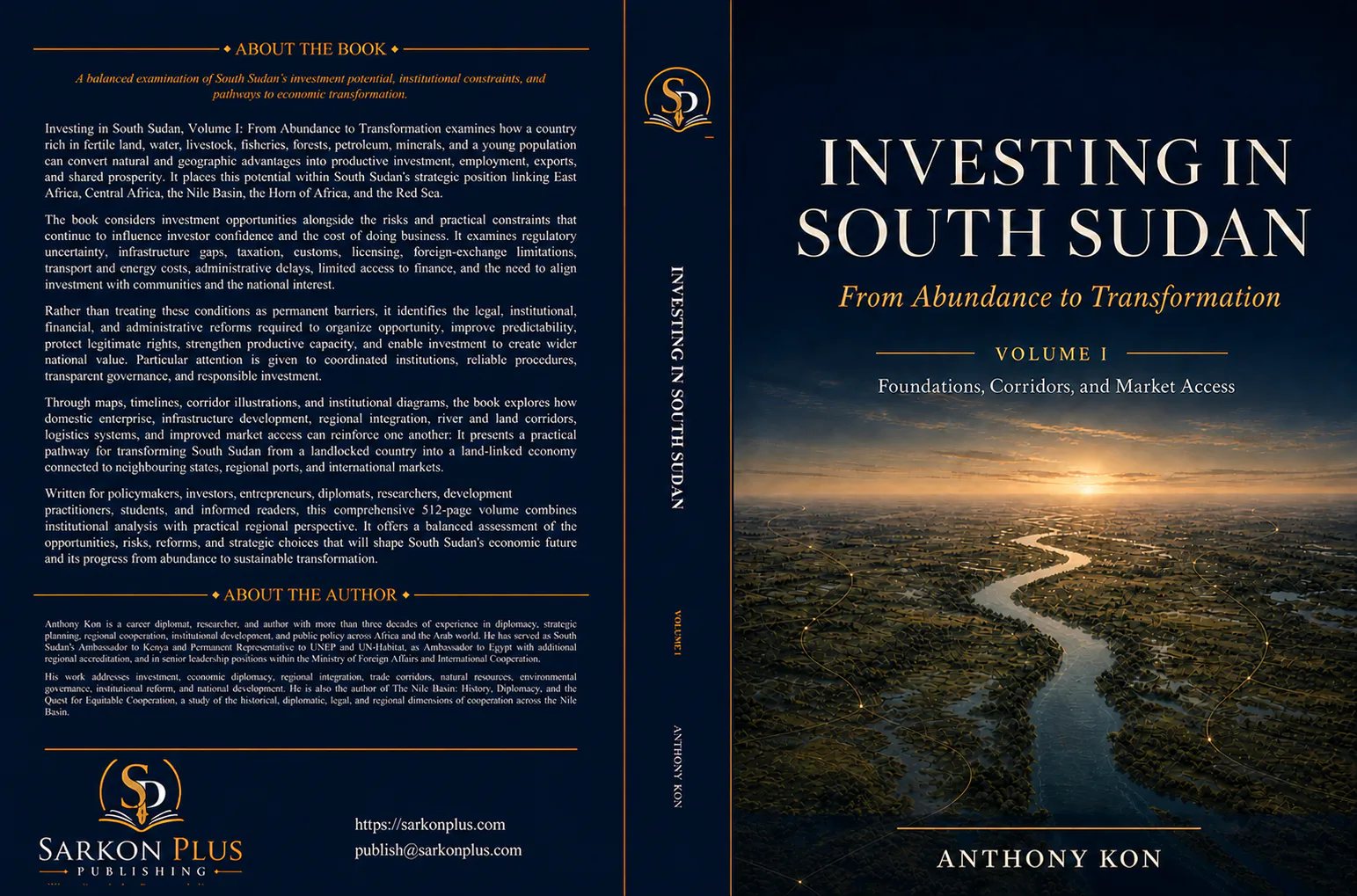
South Sudan is too often described through the language of crisis. This book begins from a different but disciplined premise: the country's risks are real, yet so are its historic possibilities.
Investing in South Sudan: From Abundance to Transformation examines how substantial natural resources, agricultural potential, livestock, fisheries, energy, strategic geography, and a young population can be organised through stronger institutions, credible policy, productive investment, infrastructure, regional connectivity, and effective markets.
Volume I focuses on the foundations that determine whether investment can enter, operate, expand, and contribute meaningfully to national development. It examines constitutional and legal frameworks, investment promotion, business formation, taxation, customs, banking, foreign exchange, labour, skills, trade facilitation, regional integration, logistics, and access to markets.
Particular attention is given to the practical systems connecting South Sudan to Mombasa, Nimule, Naivasha, Port Sudan, Renk, Paloch, Melut, Wau, the White Nile, and wider regional markets.
The book is analytical rather than promotional. It recognises insecurity, institutional weakness, infrastructure constraints, foreign-exchange pressure, data limitations, and the need for careful due diligence.
At the same time, it asks how those constraints can be addressed through reform, coordination, responsible partnerships, and long-term investment.
Its central argument is straightforward: South Sudan's challenge is not the absence of opportunity, but the organisation of opportunity.
The country's future will depend not simply on what it possesses, but on whether it can transform abundance into productive systems, those systems into confidence, and that confidence into broad-based and sustainable national value.
THE PURPOSE
South Sudan does not need exaggerated promises. It needs credible preparation, functioning institutions, responsible investment, and projects capable of building productive capacity.
Available from Amazon
Current formats and purchasing options are available on Amazon.
View Volume I on AmazonSarkon Plus Publishing
Read Anthony Kon's biography →