
The Nile Basin by Anthony Kon | Book Preview
Featured Publication

The Nile Basin

History, Diplomacy, and the Quest for Equitable Cooperation
Anthony Kon Seasoned Diplomat • Researcher • Author
History explains the Nile. Diplomacy shapes its future.

A landmark study on the politics, history, diplomacy, law, and future of one of the world's most strategic international river basins.
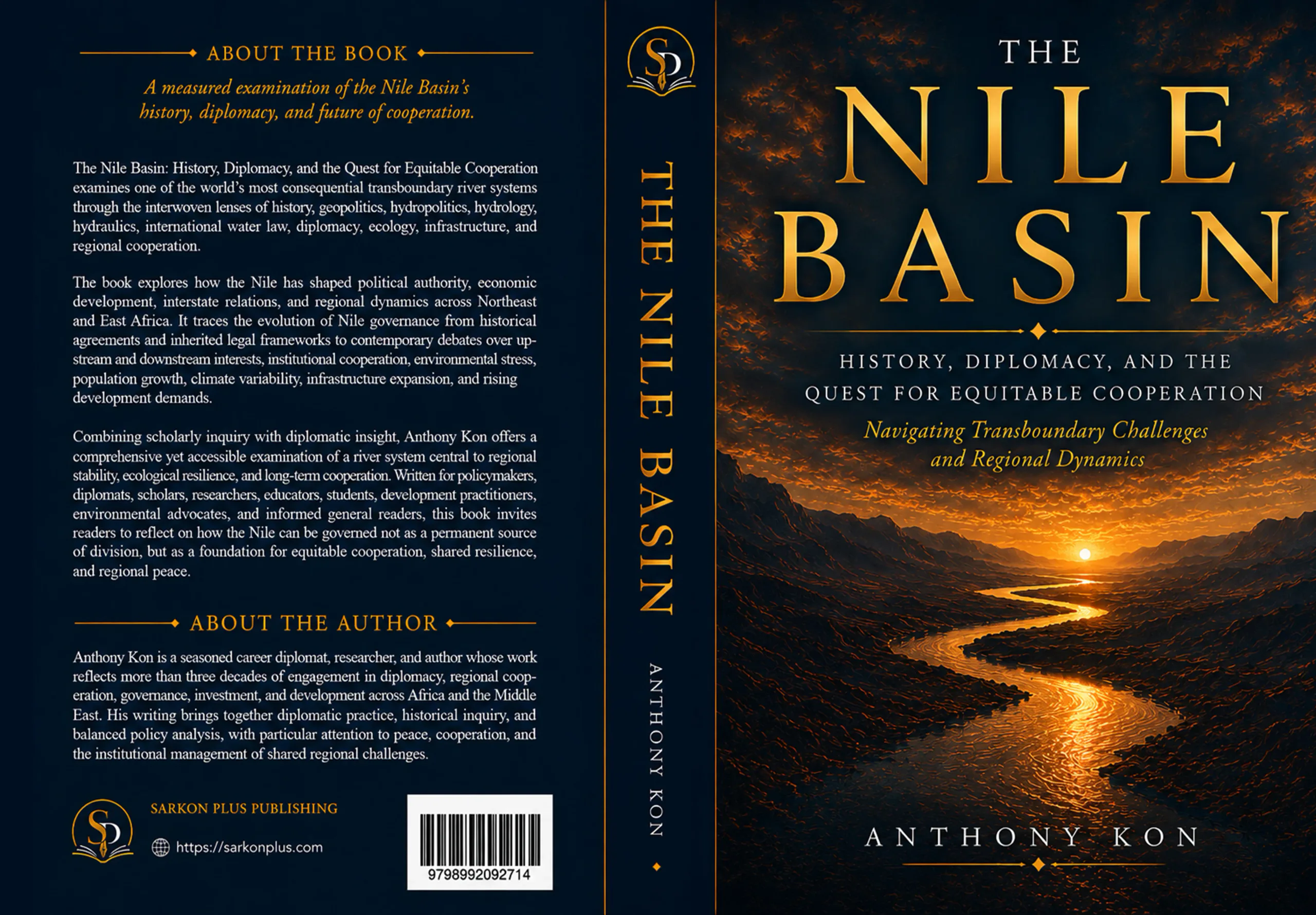
The Nile Basin: History, Diplomacy, and the Quest for Equitable Cooperation by Anthony Kon
BOOK OVERVIEW

About the Book

A comprehensive examination of one of the world's most consequential transboundary river systems through historical, legal, diplomatic, institutional, and ecological perspectives. Drawing upon diplomatic experience and rigorous research, this work explores pathways toward equitable cooperation, regional stability, and sustainable management of shared water resources.

By charting the history of diplomacy along the Nile and examining the complex regional agreements and institutional initiatives, the work offers valuable, forward-looking policy frameworks for a peaceful and politically and environmentally sustainable future among Nile Basin nations.

Publisher Sarkon Plus Publishing
Edition First Edition
Publication May 2026
Language English
Formats Kindle • Paperback • Hardcover
ISBN-13 eBook: 9798992092707 · Paperback: 9798992092714 · Hardcover: 9798992092721
Pages 468
Book Overview

About the Book

“A comprehensive exploration of history, diplomacy, international law, regional cooperation, and the future of one of the world’s most strategically significant shared river systems.”

The Nile Basin: History, Diplomacy, and the Quest for Equitable Cooperation examines one of the world’s most complex transboundary river systems through historical, legal, institutional, diplomatic, and ecological perspectives. Drawing on decades of diplomatic experience and sustained analytical inquiry, the book moves beyond familiar narratives of contestation to explore the foundations of structured and durable cooperation.

By situating the Nile within its historical trajectory, the book examines the evolution of agreements, the role of institutions, the expansion of infrastructure, and the increasing pressures created by climate change and population growth. Particular attention is given to how principles of international water law, adaptive governance, and regional coordination can be translated into practical mechanisms capable of sustaining cooperation under conditions of constraint.

The analysis engages both upstream and downstream perspectives, examining how differing historical experiences, levels of dependence, and development priorities shape national positions. It also advances a structured understanding of how cooperation can be progressively realized across the basin.

By bringing together policy analysis and lived realities across the Nile Basin, the book reflects on the broader challenge of governing shared resources within a fragmented political landscape. It offers a measured and forward-looking perspective for policymakers, diplomats, scholars, researchers, students, development practitioners, and others concerned with the future of the Nile Basin and the wider question of how interdependence can be managed with discipline, equity, and long-term vision.

What You Will Discover

I

Historical Evolution

Tracing the historical development of cooperation, negotiation, and contestation across the Nile Basin.

II

International Water Law

Examining the legal principles governing transboundary rivers, equitable utilization, and shared obligations.

III

Diplomacy and Negotiation

Understanding decades of regional diplomacy, institutional engagement, and evolving national positions.

IV

Hydropolitics

Analyzing competing development priorities, power relations, national interests, and regional security concerns.

V

Climate & Development

Assessing environmental change, population growth, infrastructure expansion, and future water governance.

VI

The Future of Cooperation

Presenting practical pathways toward equitable, peaceful, and durable basin-wide collaboration.

Publication Information

Publisher Sarkon Plus Publishing
Author Anthony Kon
Edition First Edition
Publication Date May 2026
Language English
Formats Kindle • Paperback • Hardcover
Total Pages 468 pages
ISBN eBook: 9798992092707 · Paperback: 9798992092714 · Hardcover: 9798992092721
“The future, if it is to be more stable than the past, will require more than claims. It will require judgment, restraint, and the difficult discipline of cooperation.”
FROM THE AUTHOR

Author's Note

"Every serious work begins with a question. This book began with a conviction that the Nile Basin deserves deeper understanding, disciplined dialogue, and a renewed commitment to cooperation."

The Nile Basin cannot be approached lightly. It carries too much history, memory, political weight, and human consequence for that. It is a space of profound depth, where geography meets sovereignty, where livelihood meets law, and where the past continues to speak powerfully into the present.

I do not present this book as a final word. Rather, I offer it as a considered contribution to an ongoing conversation shaped by years of diplomatic experience, sustained reflection, and the conviction that the Nile must be understood not only through dispute, but through interdependence.

I have sought to approach the subject with balance, discipline, and intellectual honesty. While readers may not agree with every conclusion, I hope the work encourages thoughtful discussion rather than division, and contributes to a deeper understanding of one of the world's most important shared river systems.

At its heart, this book is guided by a simple belief: the Nile's future does not have to be shaped by inherited suspicion. It can instead be guided by wisdom, restraint, cooperation, and a shared commitment to future generations.

Anthony Kon

Author

Juba, South Sudan

May 2026

BOOK STRUCTURE

Inside the Book

"This volume is organized to guide readers from the historical foundations of the Nile Basin through its legal, diplomatic, institutional, environmental, and strategic dimensions before concluding with practical pathways for future cooperation."

FOUNDATIONS

History and Geography

Explore the historical evolution of the Nile Basin, the physical geography of the river system, and the origins of regional interaction.

LAW

International Water Law

Examine treaties, customary international law, equitable utilization, and evolving legal principles governing shared rivers.

DIPLOMACY

Regional Diplomacy

Understand decades of negotiations, institutional development, political dialogue, and regional engagement.

INFRASTRUCTURE

Hydraulic Development

Assess major dams, irrigation systems, energy projects, and infrastructure shaping the basin's future.

ENVIRONMENT

Climate and Sustainability

Analyze environmental pressures, climate change, population growth, ecosystem resilience, and adaptive governance.

THE FUTURE

Cooperation & Shared Prosperity

Present practical recommendations for equitable cooperation, institutional strengthening, and long-term regional stability.

"This book combines historical research, diplomatic experience, legal analysis, institutional assessment, and strategic policy recommendations to provide a comprehensive understanding of one of the world's most consequential international river basins."

468+

Pages of Analysis

Detailed scientific, diplomatic, and legal scholarship.

27

Comprehensive Chapters

Systematically covering every primary regional dynamic.

100+

Years Evaluated

Of historical and diplomatic developments fully examined.

Why This Book Matters

Understanding the Nile Means Understanding the Future

The Nile Basin is more than a river system. It is a living intersection of history, diplomacy, law, development, environmental stewardship, regional security, and human survival. Decisions made today will influence the prosperity and stability of hundreds of millions of people for generations to come.

Regional Stability

Explores how water cooperation contributes to peace, confidence-building, and regional security across the Nile Basin.

Economic Transformation

Examines the relationship between shared water resources, infrastructure, trade, energy, food production, and long-term economic growth.

Climate Resilience

Analyzes the growing impact of climate change, environmental pressures, drought, flooding, and adaptive governance.

International Law

Provides a practical understanding of international legal principles governing shared rivers and transboundary cooperation.

Diplomatic Practice

Draws upon diplomatic experience to explain negotiation processes, confidence-building, and institutional dialogue.

Future Generations

Demonstrates why equitable cooperation today will shape regional prosperity, environmental sustainability, and peace tomorrow.

The future of the Nile Basin will be determined not only by geography, but by the wisdom, discipline, and cooperation of those entrusted with its stewardship.

KEY INSIGHTS

What You Will Discover

Across more than 468 pages, this book explores the historical evolution, legal foundations, diplomatic negotiations, institutional development, environmental realities, and strategic future of one of the world's most consequential international river basins. Moving beyond familiar narratives, it provides an integrated understanding of how history, law, diplomacy, development, and regional cooperation intersect to shape the future of the Nile Basin.

INSIGHT 01

Historical Foundations

Trace the evolution of the Nile Basin from ancient civilizations through colonial agreements to contemporary regional cooperation.

INSIGHT 02

International Water Law

Understand the legal principles governing equitable utilization, shared resources, and transboundary water management.

INSIGHT 03

Regional Diplomacy

Examine decades of negotiation, institutional dialogue, confidence-building, and multilateral engagement among Nile Basin states.

INSIGHT 04

South Sudan's Emerging Role

Explore how the independence of South Sudan introduced a new geopolitical, legal, environmental, and diplomatic dimension to the Nile Basin, creating new opportunities and responsibilities within the basin's evolving cooperative framework.

INSIGHT 05

Infrastructure and Sustainable Development

Assess the strategic importance of dams, irrigation, hydropower, navigation, food security, climate resilience, and regional connectivity.

INSIGHT 06

A Framework for Future Cooperation

Discover practical recommendations that promote institutional strengthening, mutual confidence, adaptive governance, and long-term basin-wide cooperation.

FEATURED READ

A Distinctive Perspective

Rather than viewing the Nile exclusively through conflict or competition, this book examines the basin as a shared strategic system requiring historical understanding, legal clarity, diplomatic engagement, environmental stewardship, and long-term institutional cooperation. Particular attention is given to the evolving role of South Sudan within the basin and the opportunities presented by a more inclusive regional dialogue.

Historical Analysis
Diplomatic Experience
Policy-Oriented Research
Regional Perspective

"The future of the Nile Basin will depend not upon the victory of competing claims, but upon the strength of shared responsibility."